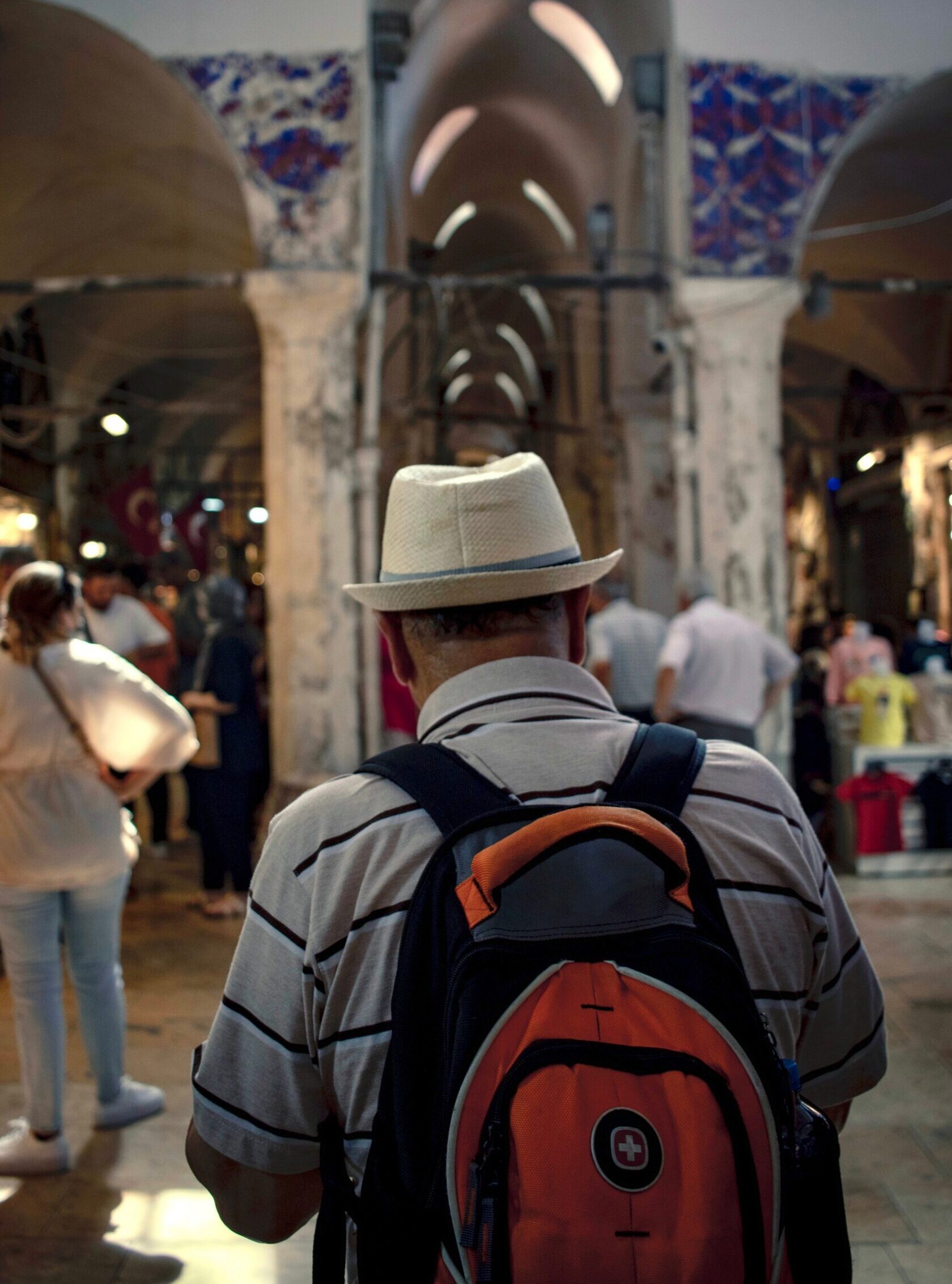
Photo by Zeynep Sude Emek
What happens when a country becomes a product?
The airport was busy, as airports usually are. Thousands of people moving in different directions. Suitcases rolling across the floor. Screens constantly changing. Announcements cutting through the noise. Everyone seemingly going somewhere.
I was working in the self-service bag drop area when I noticed him. His eyes were locked on me from a distance. He kept walking towards me until he finally stood in front of me.
“I need help.”
My instinct was immediate. What can I do to help?
When you work with passengers, you never really know who is going to approach you or what they might need. So I asked him what I could help him with.
“I’ve missed my flight. Get me on another one.”
He needed to be rebooked. I asked which airline he was travelling with and began explaining that, unfortunately, my department did not operate that airline. I tried to explain where he needed to go instead.
But he seemed suspicious. It was as if he could not understand why I could not simply solve the problem for him. Maybe he thought I had misunderstood him. Maybe he thought there had to be another solution.
So we explained it again. And again. The situation went around in circles.
Then his frustration boiled over.
“I NEED FUCKING HELP NOW!”
“I understand that clearly, sir. But listen to what I’m trying to explain to you.”
He kept going.
Eventually, he looked at me and said:
“Fuck you. Fuck this airport. Fuck your country.”
That last part felt personal.
Not because I believed I was responsible for what had happened to him. I wasn’t.
I was simply standing there, trying to help a stranger who had missed his flight.
But somehow, his frustration had become bigger than the situation itself. I was no longer a person trying to help him. I had become part of the problem in his eyes.
My first thought was simple:
What gives you the right to treat another human being like this?
I asked him several times to calm down.
A couple of my colleagues eventually came over and backed me up. Something changed when they arrived. The energy disappeared from him. The man who had moments earlier filled the space with anger suddenly seemed much smaller.
Eventually, the situation ended.
But the thought stayed with me.
Some people have very little consideration for other people.
And perhaps that is where the story becomes bigger than one angry passenger.
Because when we travel, we do not leave ourselves behind at home.
We bring our expectations with us.
Our habits.
Our frustrations.
And sometimes, our sense of entitlement.
THE VACATION WE THINK WE DESERVE
There is something interesting about the relationship between tourism and entitlement.
For many people, a holiday is not simply a few days away.
It is something they have worked for.
Months of work. Bills paid. Money saved. A long wait for those few days when they can finally step away from everyday life.
The holiday becomes the year’s breathing space.
And because of that, it can become an extremely sensitive point.
When something goes wrong, it may no longer feel like a small inconvenience.
You miss the flight.
The hotel is not what you expected.
The restaurant disappoints you.
The service is slow.
The weather is terrible.
Suddenly, the thing you have waited for all year feels threatened.
And somewhere along the way, “I have earned this holiday” can quietly become “I deserve to be treated accordingly.”
There is nothing wrong with wanting a good holiday.
There is nothing wrong with wanting comfort, good food, a nice hotel or a few days where someone else takes care of the details.
The problem begins when the country you are visiting starts to feel like a product designed around your needs.
Because it isn’t.
There are people living there.
People going to work.
People raising families.
People struggling with money.
People having good days and bad days.
People who were not on holiday when you arrived.
YOU ARE NOT HOME
There is one sentence I think every traveller should remember:
You are not home.
It does not mean you have to abandon your values or cross your personal boundaries.
It means understanding that you have entered someone else’s environment.
There are different rules.
Some are written in law.
Others are invisible.
Social customs.
Religion.
Traditions.
Ways of speaking.
Ways of eating.
Ways of living.
You do not have to agree with everything.
But you should be able to see another culture at eye level.
Not above it.
Not beneath it.
And not automatically through the standards you brought with you.
Travelling requires a willingness to step outside your own cultural rulebook.
Not completely.
But enough to understand that your way of doing something is not necessarily the only way.
Sometimes the most useful question is surprisingly simple:
Is this actually wrong — or is it just different from what I know?
That question can stop a lot of prejudice before it begins.
THE TOURIST WHO EXPECTS THE WORLD TO BEND
Maybe this is one of the biggest changes in modern tourism.
We have become consumers everywhere.
We expect speed.
Convenience.
Choice.
Personalisation.
And increasingly, we expect the same logic when we travel.
We pay, therefore we expect.
We book, therefore we deserve.
We are on holiday, therefore everything should work.
But another country is not a customer-service department.
A foreign city is not an extension of your living room.
And the people who work there are not characters in your holiday.
Imagine sitting in an expensive Moroccan restaurant.
You order a large meal. Something special. Something you might not eat at home.
The food arrives.
The restaurant looks beautiful.
The evening feels extraordinary.
But what happens if, for a moment, you step outside your own perspective?
You might begin to see something else.
A waiter working a long shift.
A chef who has spent years learning his craft.
People working hard because the restaurant needs customers to survive.
Perhaps someone has children waiting at home.
Perhaps someone is trying to build a better life.
The experience you are consuming is their everyday reality.
That does not mean you should feel guilty for enjoying it.
It means you should see the human beings behind it.
There is a difference between being served and being superior.
WHAT DO WE OWE A PLACE?
Perhaps the answer begins with something very simple:
Respect.
The way you speak to people.
The amount you demand from them.
The space you take up.
The willingness to listen.
The willingness to be patient.
The willingness to support local people and businesses when you can.
Try the local food instead of automatically eating the same international chain you could have eaten at home.
Walk down the smaller streets.
Visit local shops.
Talk to people.
Spend some of your money where it reaches ordinary people rather than only the largest international brands.
Stay curious.
Be humble.
Not because the people of another country are somehow more important than you.
But because they are just as human as you are.
WHO IS THE CITY FOR?
This becomes more complicated when tourism grows large enough to change the place itself.
A city can benefit enormously from visitors.
Tourists bring money. They create jobs. They support restaurants, hotels, guides, drivers and countless small businesses.
But at what point does the visitor stop being a guest and start becoming a force that reshapes the home of everyone else?
What happens when housing becomes more expensive?
When neighbourhoods begin changing around visitors?
When local businesses disappear and international chains take their place?
When a city begins to feel like it was designed more for people passing through than for the people who actually live there?
These are not simple questions.
Tourism is not inherently bad.
A family that works hard, saves money and takes a week away together should not be blamed for the problems created by an entire tourism industry.
But perhaps we should ask what kind of tourism we are building.
A place should not have to erase its own identity to make itself attractive to visitors.
Because eventually, the thing people travelled there to experience may be the very thing tourism has removed.
THE GUEST
I keep coming back to the idea of being a guest.
Think about being invited into someone’s home.
You do not walk through the door and immediately start rearranging the furniture.
You do not open their fridge without asking.
You do not jump on their bed.
You do not leave your rubbish on the floor.
And you certainly do not insult the entire family because something did not go your way.
You behave with a certain awareness.
You understand that you are entering someone else’s space.
Maybe travelling should carry some of that same humility.
THE CHAIN REACTION
I have experienced the opposite.
In Albania, I have been given a free cup of coffee.
I have had two bottles of water given to me by a local shopkeeper.
I have even been given a free taxi ride.
None of these things were huge.
But they stayed with me.
They made me feel welcome.
And they changed the way I saw the country.
I began recommending Albania to other people.
I became more curious about its culture and history.
I developed a genuine respect for the country.
That is the strange thing about human interaction.
One small act can create a chain reaction.
Someone treats you well.
You remember it.
You tell someone else.
They become curious.
They visit.
They meet more people.
And suddenly, a single cup of coffee has travelled much further than the café where it was served.
The opposite can happen too.
One bad experience can become a story about an entire country.
And that is where we need to be careful.
Because one person is not a population.
One encounter is not a culture.
One bad day is not an entire country.
VISIT OR EXPERIENCE?
There is a difference between visiting a country and experiencing one.
You can cross a border.
See the capital.
Visit the famous attractions.
Take pictures.
Eat at the restaurants recommended by an algorithm.
Stay in a five-star hotel.
And leave.
You have visited. But perhaps you have not really experienced the place.
To experience a country, you have to become a little more curious.
Walk down the narrow street.
Look into the small shop.
Try the food you cannot pronounce.
Talk to someone.
Notice how people live.
Pay attention to the things that are not designed for tourists.
You begin to see the place beyond the postcard.
And sometimes, that is where the real experience begins.
WHEN EVERYTHING BECOMES CONTENT
Social media has made this both easier and harder.
Easier because we can now see almost anything.
We can watch someone walk through a Moroccan market.
See the streets of Tokyo.
Explore villages in Albania.
Watch someone hike through the mountains.
We can learn before we arrive.
But there is a strange paradox.
The more we document travel, the easier it becomes to turn the experience into a performance.
Every meal becomes content.
Every sunset becomes a photograph.
Every hidden street becomes a location to post.
And sometimes, we stop experiencing the moment because we are already thinking about how the moment will look to someone else.
I do not think photographs are the problem.
I take them too.
A photograph can preserve something you would otherwise forget.
But there is a difference between preserving a memory and living for the image of it.
THE MEMORY YOU NEVER FILMED
One of my clearest travel memories has no photograph.
When I was a child, I travelled to the Phi Phi Islands in Thailand with my father.
We rented a small boat and went into a lagoon surrounded by jungle-covered cliffs.
The water was incredibly clear and warm.
At some point, it started raining.
I remember floating in the water while the rain hit the surface around me.
My ears were underwater.
I could hear the strange muffled sound of the water while the drops continued falling around me.
There was no phone.
No video.
No photograph.
Nothing to prove that it happened.
And yet I still remember it.
Maybe more clearly than some moments I have photographed hundreds of times.
Because I was not thinking about capturing the moment.
I was simply inside it.
Sometimes the most unforgettable experiences are the ones you could never have planned.
WHAT TRAVEL SHOULD DO TO US
Maybe that is what travel should ultimately do.
Not just entertain us.
Not just give us a break from work.
Not just give us photographs.
It should challenge us.
It should make us question things.
It should make us see our own country differently when we return.
It should make us grateful for what we have.
And perhaps make us recognise what we are missing.
Travelling has made me question what a good life actually looks like.
Which parts of my own culture are worth protecting?
Which things have I simply accepted because I was born into them?
What does community mean?
What does hospitality mean?
What does identity mean?
And how much of who we are is simply the result of where we happened to be born?
The more you travel, the harder it becomes to believe that your own way of living is the only possible way.
You begin to realise how many different ways there are to live.
And that can make you less eager to judge people who are different from you.
Perhaps that is one of the greatest things travel can give us:
Perspective.
GO HOME, TOURIST
So what does GO HOME, TOURIST actually mean?
It does not mean tourists are not welcome.
It does not mean you have to agree with every culture you encounter.
It does not mean you should abandon your identity or your personal boundaries.
It means something much simpler.
If you enter another country with arrogance, disrespect and the belief that everyone should bend around your needs, then perhaps you should turn around.
Because you are not at home.
You are a guest.
And being a guest comes with responsibility.
To be patient.
To be respectful.
To be humble.
To be curious.
To recognise difference without immediately condemning it.
And perhaps most importantly:
Think before you act.
The next time something goes wrong on your holiday, take a breath.
Look at the situation.
Ask what actually happened.
Do not turn one person into an entire population.
Do not turn one bad experience into an entire country.
Do not let one moment of frustration decide what you think about millions of people.
Because the world is much bigger than our own perspective.
And if we are willing to step outside of it for a moment, we might discover that travelling is not only about seeing the world.
It is about learning how to see other people.
And perhaps, in the process, learning how to see ourselves.